

Feels good to come back to writing after a long time. Had to take a break (cos some professional reasons) but what an exciting time to get back!
The popular view over the last couple of months is a simple binary: global money is fleeing the AI trade in Korea, Taiwan and China, and India, the market with almost no AI hardware exposure, will catch it. October seems to have given this view some legs.
I think that view is too “binary” and the truth is slightly more nuanced. The AI sell-off may not rescue India, for three reasons. The AI boom is now debt-funded, and that debt is keeping US yields above 5%, so money leaving AI can simply sit in Treasuries. At that yield, with the rupee near 95, India has to clear a much higher bar to attract foreign money. And crude above $100 is squeezing Indian margins just when the earnings story needs to be strongest.
The hope: October looked like a rotation
The AI unwind was almost brutal in North Asia. Korea’s KOSPI fell 16.2% in October, its seventh-worst month on record. China’s CSI 300 lost 8.5%, its worst month in a decade. The Nifty rose 1.9% and Nifty IT jumped 17.7%.
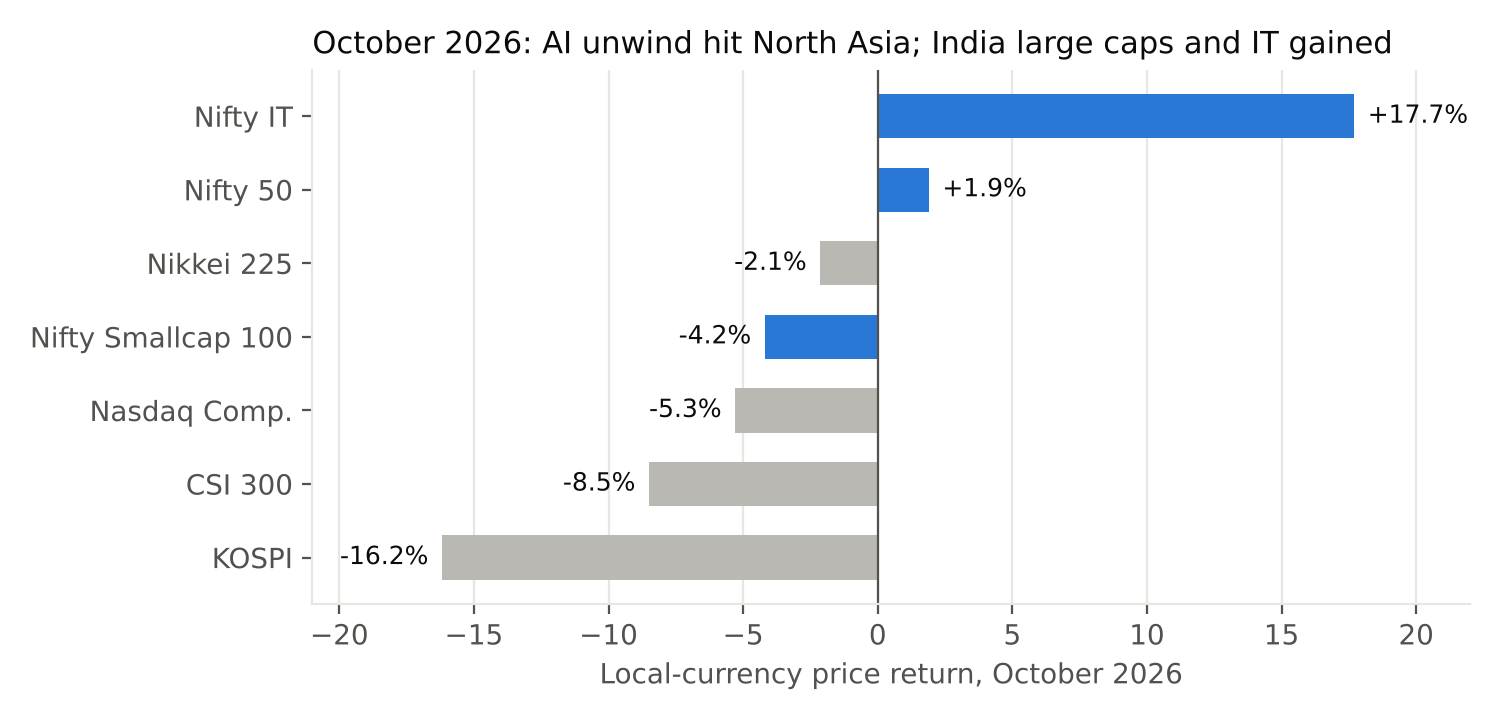
Foreign investors turned buyers in the last ten trading days of October, putting in about ₹30,000 crore. But look closer and the rally was narrow: the Nifty Smallcap 100 fell 4.2% in the same month, the BSE500 was down -1.1% (not on the chart). October was a relative win definitely, not a flood of new money. FIIs still sold ₹21,153 crore for the month & SIPs, lifeline of the Indian markets, seem to be stagnating at ~32,000 crores (this is not a verdict on SIPs or DIIs, do not get me wrong).
Reason 1: AI debt is keeping US yields high
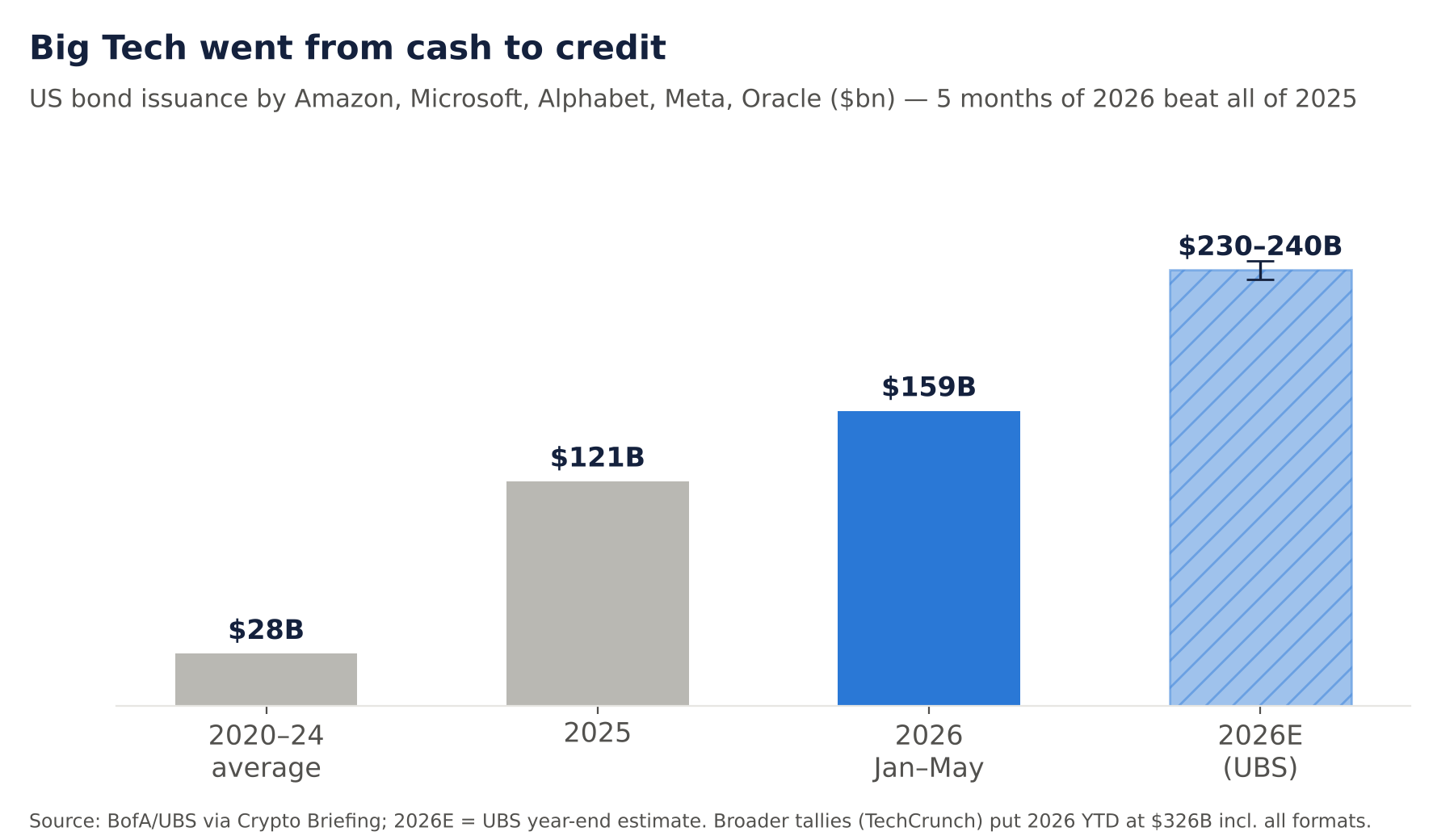
For a decade, Big Tech funded its ambitions from the cash it generated. Not anymore. In the first five months of 2026, Amazon, Alphabet, Meta, Microsoft and Oracle sold $159 billion of bonds, more than all of 2025 and about four times their 2020–24 average. Goldman Sachs expects about $420 billion of hyperscaler issuance in 2027.
They borrow because capex has outrun cash. Combined 2026 capex guidance is about $730 billion. In the September quarter, the total operating cash flow of Alphabet, Meta and Amazon put together was at –$117.5 billion Vs total capex of –$162.5. As per an Yahoo article that quotes Goldman Sachs, these three companies sit on about $3.2 trillion of off-balance-sheet leases and purchase commitments (Yahoo Finance via AOL, citing Goldman Sachs).
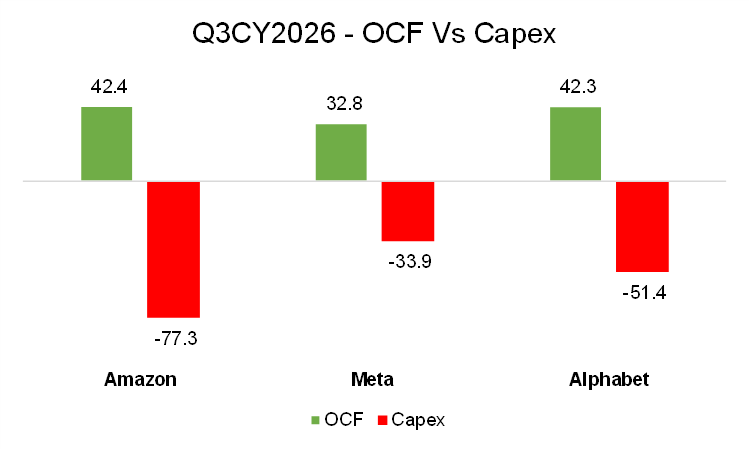
Source: Company Filings, Bloomberg
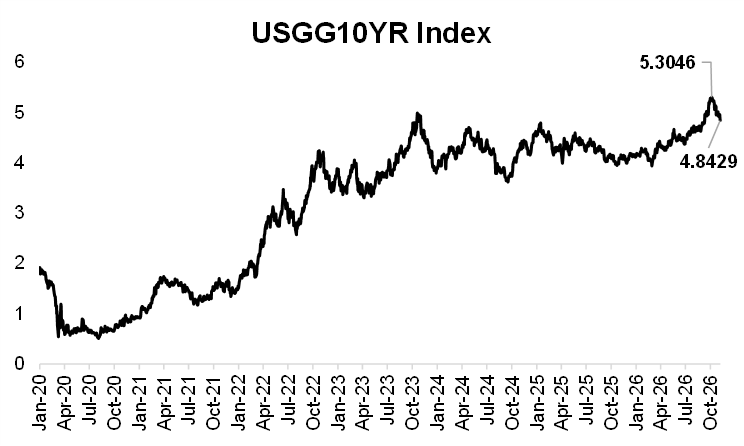
This is long-dated debt, 41% of hyperscaler bonds mature beyond 15 years, against 16% for the corporate index (TwentyFour AM). It competes with a US government running 6%-of-GDP deficits for the same long-term savings. Investors have responded by demanding more: the 10-year term premium (the extra return that investors want for holding long dated securities) more than doubled this year, from 0.46% in February to 1.07% in October.
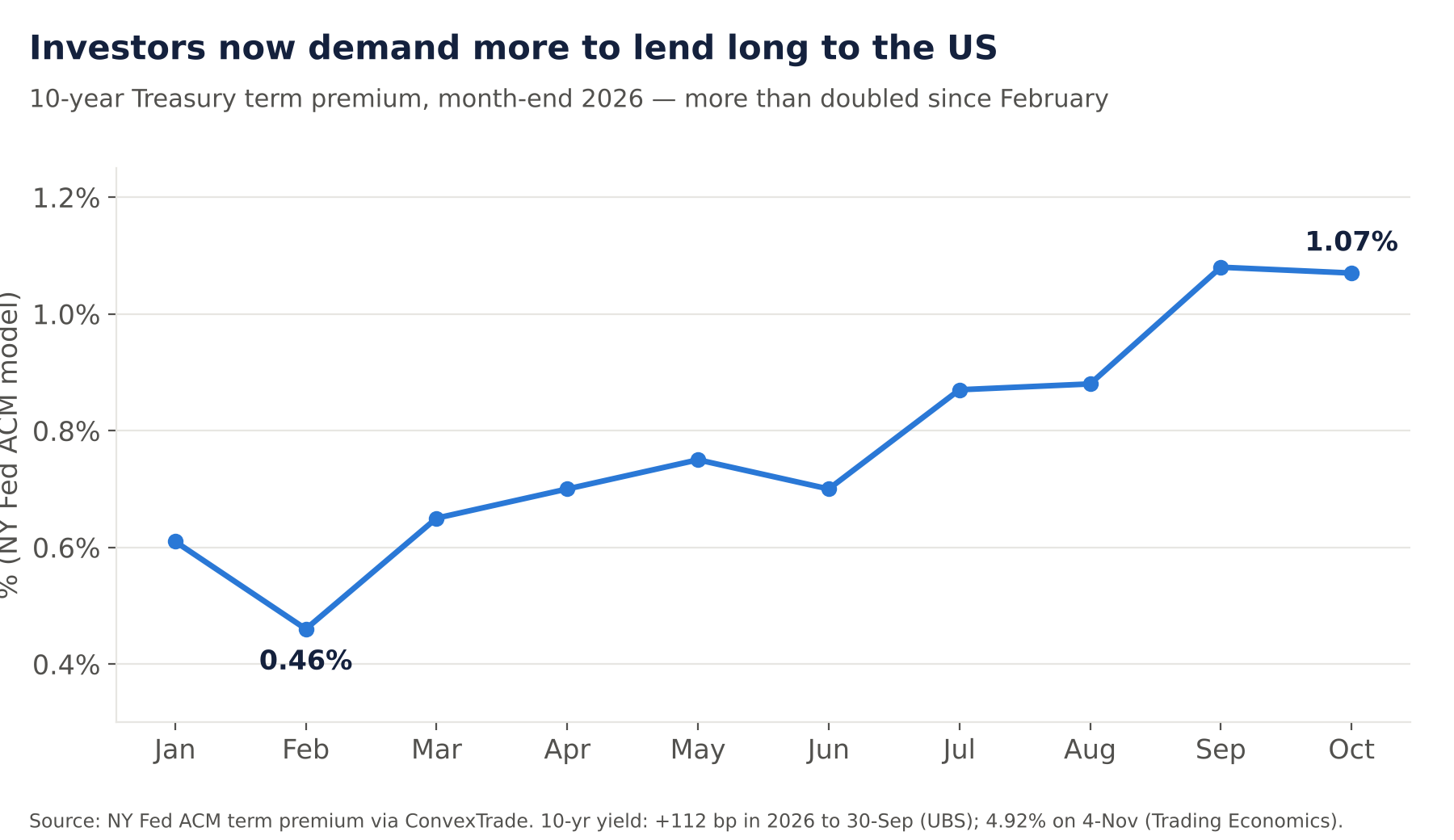
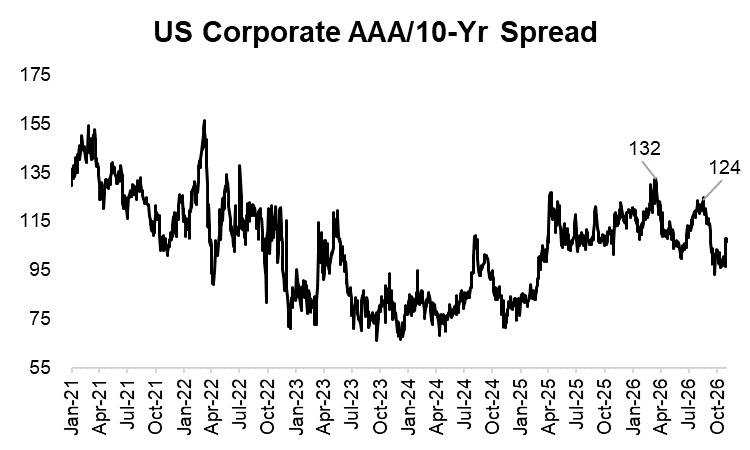
The 10-year Treasury yield rose 112 basis points in 2026 to 5.30% at mid-October and was at 4.84% recently. Corporate spreads have been around100bps, for the whole of CY26.
Source: Bloomberg
Why this matters for India: when money leaves Samsung or TSMC, it doesn’t have to buy HDFC Bank!! It can earn nearly 5% in Treasuries with no equity risk and no currency risk. The AI boom’s own debt has made that parking spot more attractive.
Reason 2: India now has to clear a much higher bar
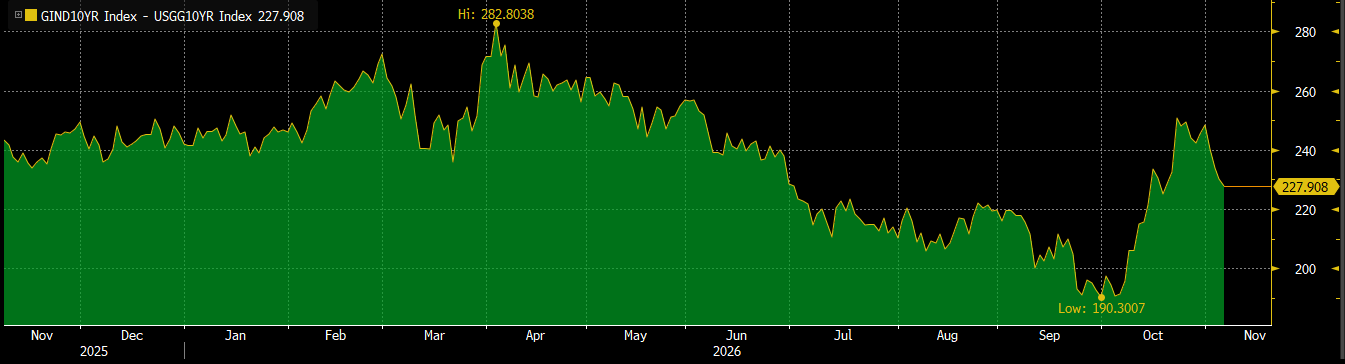
A foreign investor in Indian equities has to beat the US risk-free rate, cover rupee depreciation and get paid for equity risk. In October the India–US 10-year spread was only about 230 basis points while the rupee was losing about 3.45% a year — barely enough to cover currency risk. The rupee has gone from 89.84 to about 95 per dollar this year.
Source: Bloomberg
The flow data shows what that does. FPIs have pulled ₹2.95 lakh crore out of Indian equities in 2026 — 2.4 times the previous record outflow of 2022. (This is a known data, pick it up from any source)
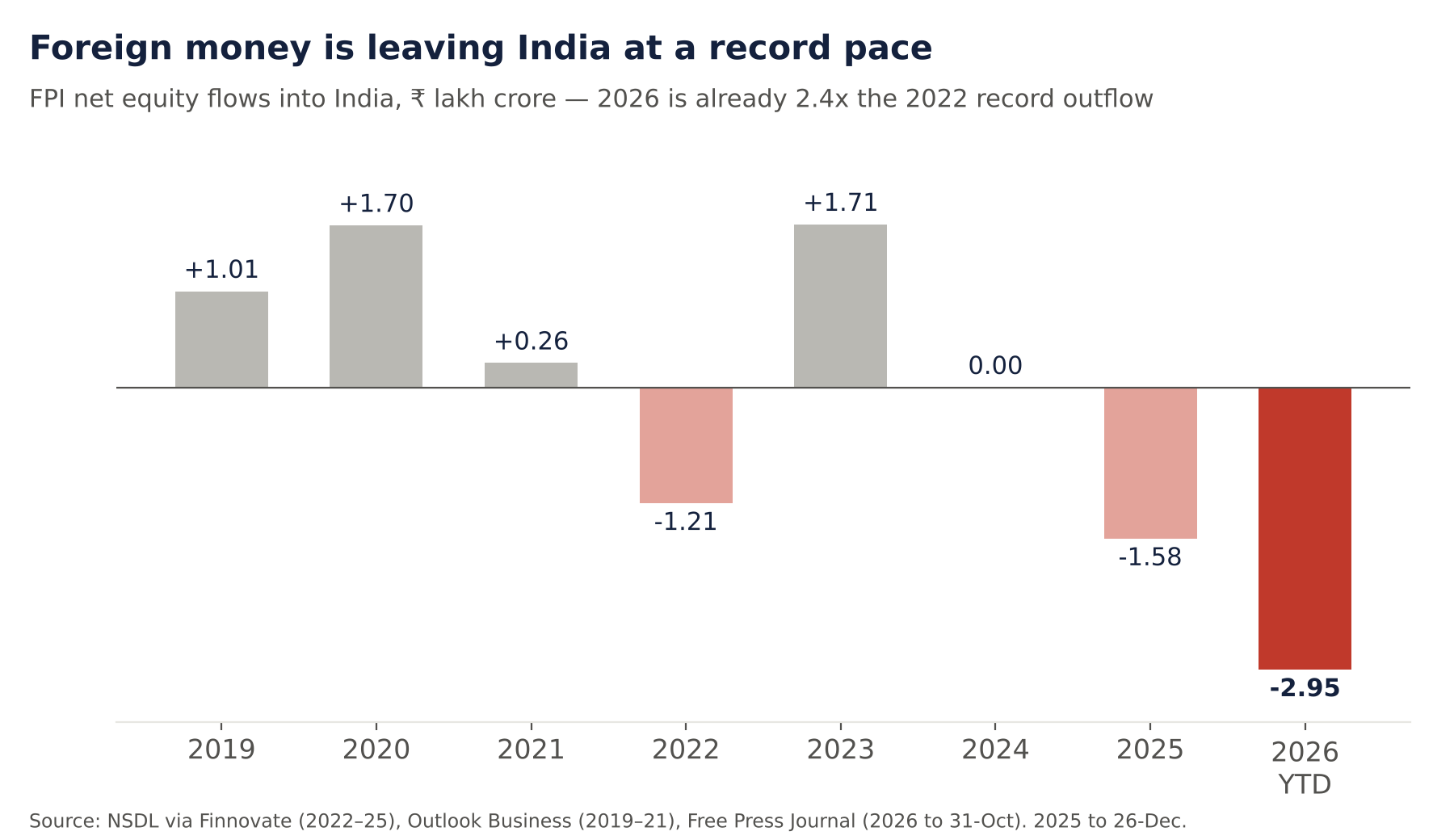
And here is the uncomfortable part: emerging markets as a whole still drew about $34 billion of inflows this year (UBS). The money went to Korea and Taiwan’s AI stocks and India, in a way, was the funding source. India’s weight in the MSCI EM index fell from about 21% in September 2024 to 10.65% in September 2026 (MSCI factsheet). If AI money exits Asia, it is just as likely to go home to dollars as to come to India.
Reason 3: crude is eating into India’s margins
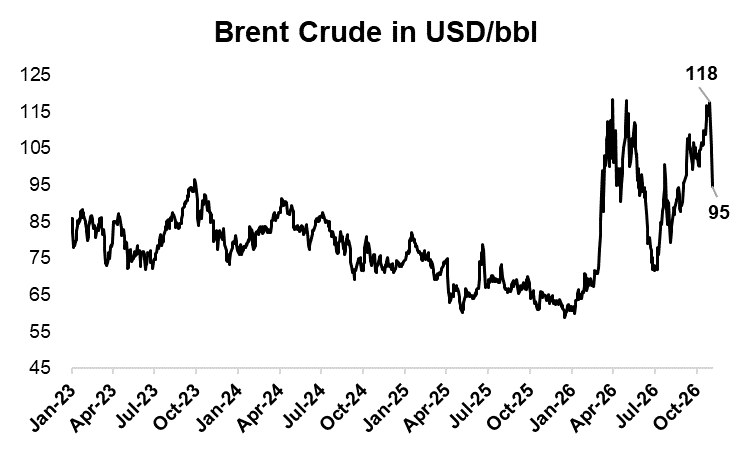
Brent has been above $100 since 9th September (its cooled off now after the American Mid terms) and peaked in April after the war on Iran began in February. Even after an ~18% fall in the last 5 trading days on hopes of a US–Iran deal and the US mid-terms it is about $95, roughly 50% above a year ago. Usually when crude moves like this, it would take ~4 quarters for the Indian margins to normalize, provided there are no other shocks.
Source: Bloomberg
India imports about 90% of its crude, and it shows up in the numbers:
Margins are slipping. In the Sept quarter, BSE 500 companies outside financials and oil & gas grew revenue 23% but EBITDA grew slower by 18% and profit by 16%. The EBITDA margin contracted by 83bps.
Estimates are falling. The Nifty’s FY27 consensus EPS has been cut from 1,357 to 1,235 in a year, about 9% (5paisa, citing JM Financial).
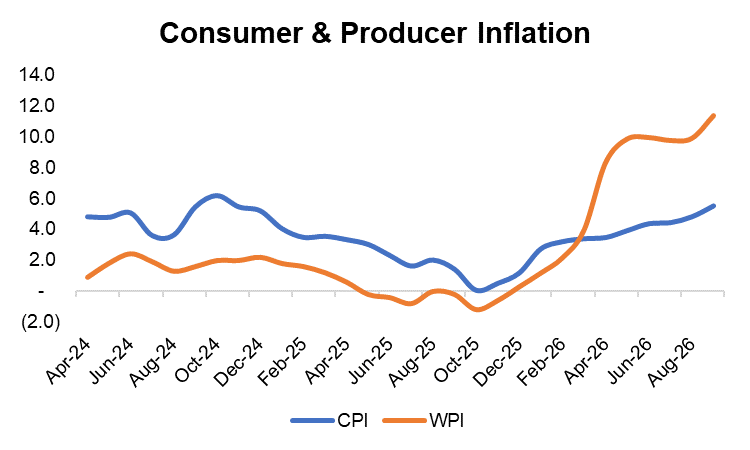
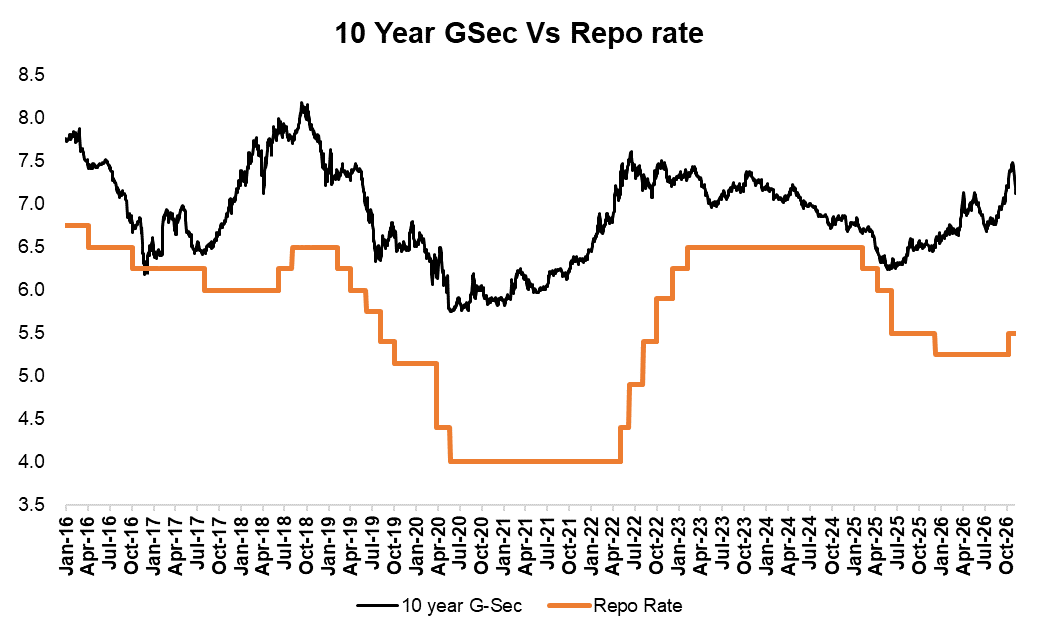
Rates can’t help. CPI and WPI are at highs and the India G-Sec yields are pricing RBI hikes in the subsequent meets, which is expected to increase the cost of capital.
Source: RBI Filings
So, a “structural” rotation trade needs a good earnings story to stick. Right now India’s broad based earnings does not look that strong.
What does history say
I looked at eight times since 1990 when a dominant global theme sold off, Japan in 1990, the Asian Tigers in 1997, dot-com in 2000, US housing in 2008, the commodity/BRIC peak in 2011, China A-shares in 2015, China tech in 2021 and US growth stocks in 2022, and compared MSCI India with MSCI EM in USD (MSCI data via Novel Investor).

The pattern is consistent. India usually falls less than the market being sold, but it rarely rallies because of it. The two clear losses, 2008 and 2011, both came when the theme’s unwind ran into tight global money or a currency shock. Every lasting win (2003–07, 2021–23) needed India’s own catalyst, a capex cycle or earnings cycle or consumption cycle and not just domestic flows and definitely not just bust or a slowdown somewhere (AI in this case).
Today’s setup looks like a tight money (Fed hiking, 10-year near 5%) and a currency stress (rupee near 95) of the losing years. What it lacks is a strong domestic earnings upgrade of the winning ones.
What would prove me wrong
A US–Iran deal - most probable after US mid-term. Citi expects Brent near $70 in Q4 2026 if one reopens Hormuz (Newsquawk). That would fix India’s margins, inflation and rupee in one stroke.
US yields keep falling. The 10-year is already ~46 basis points off its early-October high; Trading Economics’ model sees 4.68% in 12 months (Trading Economics). Below 4.5%, the Treasury parking spot looks far less attractive.
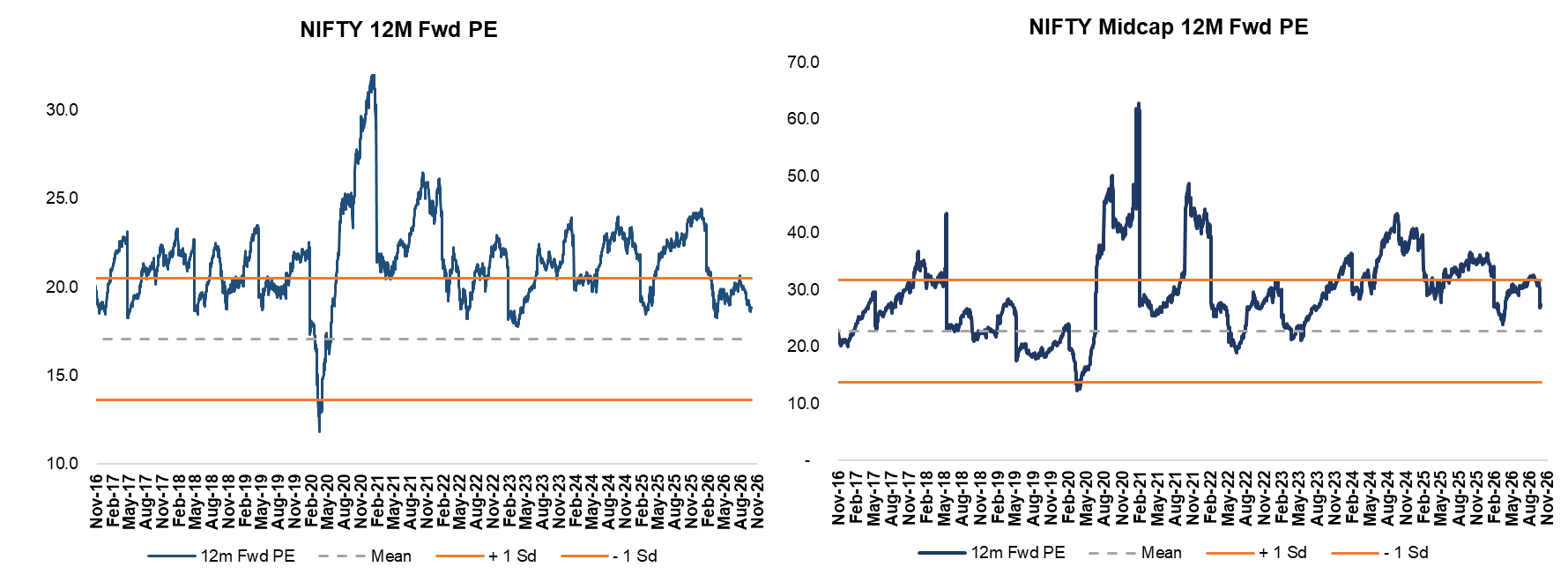
India is cheap enough to buy anyway. Both NIFTY and NIFTY Midcap are moving towards their average 12M forward PE, which makes it very attractive. Combine this with under ownership in the MSCI basket, Indian markets look very attractive. Under-owned markets can rally on very little good news.
Bottom line
The AI sell-off is good news for India in relative terms: Indian large caps will likely keep falling less than Korea, Taiwan and China. But relative isn’t absolute. As long as AI debt keeps US yields near 5% and crude stays near $100, the money leaving the AI trade has a better place to sit than India.
Three numbers decide whether that changes: Brent below $90, the US 10-year below 4.5%, and FPIs net buying for more than a couple of weeks. Until all three show up, I’d treat India as a place to hide, not a place to chase and definitely look for returns in stock selection rather than in the index.